


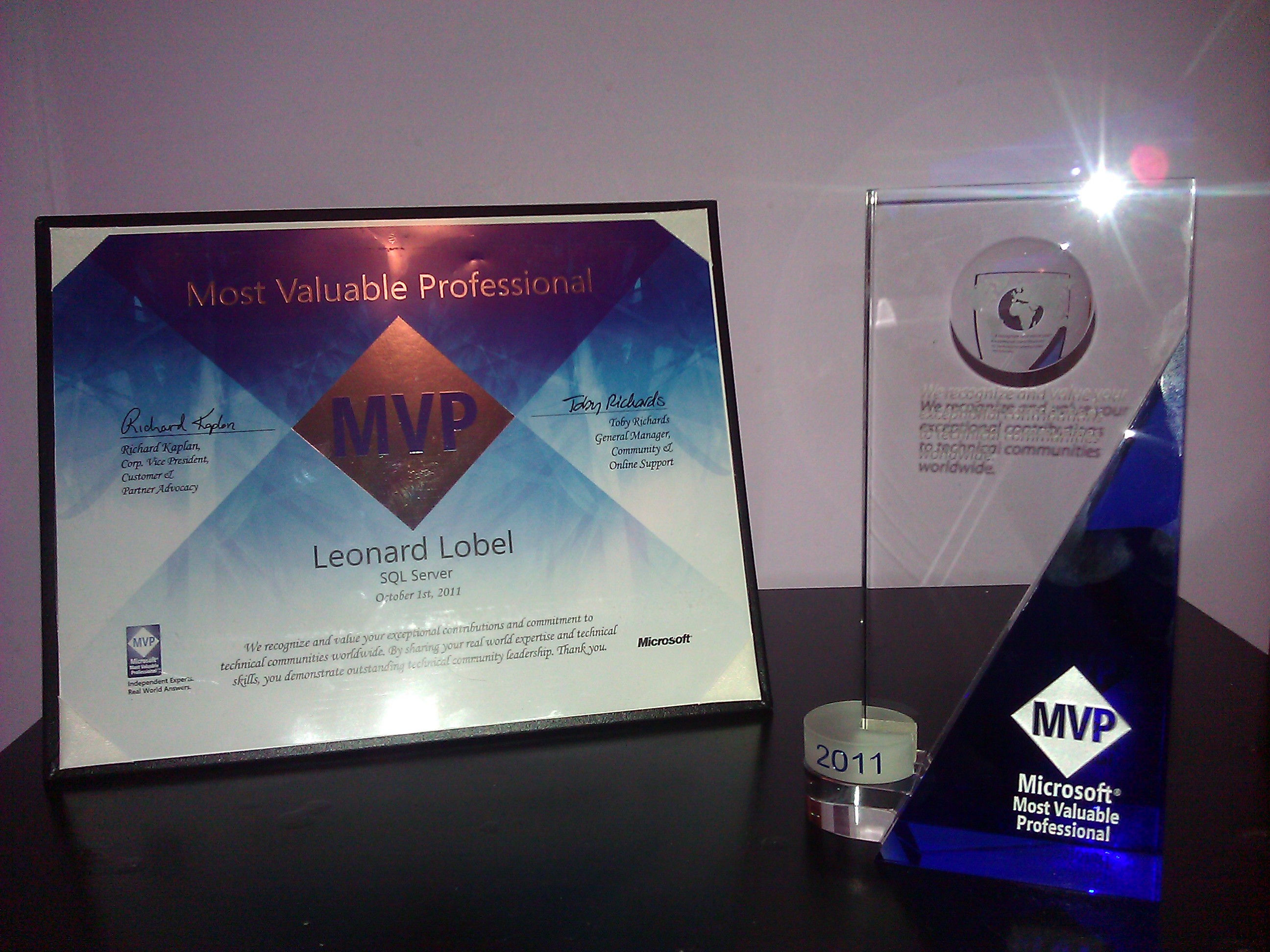
I’m extremely happy to announce that I’ve just earned Microsoft’s 2011 MVP (Most Valuable Professional) Award for SQL Server! My MVP profile is online at https://mvp.support.microsoft.com/profile/Lobel.
Microsoft recognizes independent software professionals who actively share their expertise and knowledge throughout the technical community with the MVP award. There are just over 4,000 MVPs worldwide, of which there are only 279 MVPs for SQL Server (as of October 2011). So it’s a great thrill and honor for me to join this very select group of dedicated individuals.
There’s nothing I enjoy more than helping other developers learn and grow, and that’s exactly what the MVP award is all about. So thanks to all of you out there for your readership, and I look forward to many more years of speaking and writing on SQL Server, .NET, and all things Microsoft!



October 13, 2011 at 12:13 am
Congrats Lenni! You deserve it. Your posts in SQL filestream programming saved me immense time an I hope to see more of the same.
Mark
October 13, 2011 at 12:26 am
Much appreciated Mark!
October 13, 2011 at 1:12 pm
That’s awesome man! Congrats.
October 14, 2011 at 2:50 pm
Thanks Paul!
October 14, 2011 at 1:42 pm
Congrats Lenni! Well deserved!
October 14, 2011 at 2:53 pm
Thanks so much Amy! 🙂
October 14, 2011 at 2:31 pm
Congratulation for getting award , I have been using your filestream varbinary(max) column and helped me a lot.But still stuck on generating a different Tier layers to generate it . Even the Entity Framework 4. model doesn’t support it. I hope its time to write one more article about it. or some Strongly Typed Dataset to be generated either by some software or others.
once again congrats.
October 14, 2011 at 2:53 pm
Thanks for the congrats. Not sure why you’re having difficulty with this. FILESTREAM is a total abstraction over the varbinary(max) data type, so you can build a typed DataSet against FILESTREAM by designating the BLOB column in your DataTable as a System.Byte[] type (that is, an ordinary byte array). I’ve done it before, and it works perfectly. The same should be true for the Entity Data Model in EF, though I’ve never tested it.
October 26, 2011 at 8:37 pm
Congrats Lenni!
October 26, 2011 at 8:41 pm
Thank you Lei!